Polyurethane
casting line
Continuous metering and mixing of polyol and isocyanate with mineral fillers and polymer microspheres. No styrene emission, UV stable, and stronger and more elastic than the polyester equivalent at the same mineral loading.
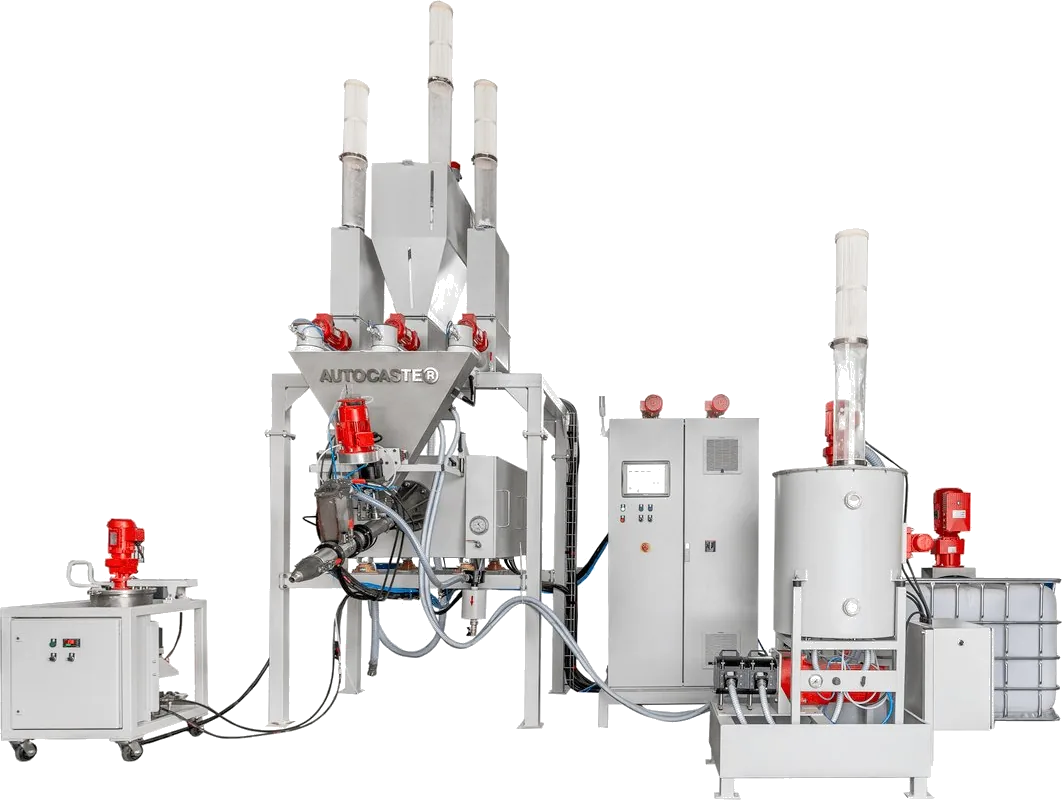
How the line works
All four binder systems run on one machine design. The five stages work as a single flow; what changes between configurations is the binder, the materials of the wetted parts, the temperature regime and the casting programme.
Dry component metering
Screw feeders for coarse and fine mineral filler with an active bridge-breaking device, WIKA level sensors and a replaceable filter cartridge on every hopper, so dust is not vented into the workshop.
Liquid component metering
Separate pump groups for resin and hardener: BAUTEC gear pumps, FESTO servo drives, pressure monitoring on each line, automatic recirculation when the machine stops.
Dynamic mixing head
Recirculation-type low-pressure head with a Siemens drive, a horizontal traverse unit for calibration and servicing, and automatic solvent flushing after every cycle.
Vacuum degassing
Degassing column with a BUSCH R5 rotary vane pump, residual pressure 0.1 mbar. Air entrained during mixing is removed before the mix reaches the mould.
Casting and control
Casting unit, 12″ touch panel, a frequency converter per metered component, recipe memory and remote diagnostics over WIFI.
Technical data
| Output of lines in service | 4–16 kg/min |
|---|---|
| Design maximum of the range | 24 kg/min, higher on request |
| Binder system | Polyurethane (polyol and isocyanate) |
| Component tanks | 2 × 180 l, stainless steel, thermostatted |
| Metering ratio, polyol : isocyanate | 2:1 … 1:2 |
| Mixing head | Patented low-pressure head, infinitely variable to 6000 rpm |
| Microsphere feeder | Expancel, ATEX design, dust-free ARO diaphragm pump |
| Vacuum degassing | Integrated column, residual pressure 0.1 mbar |
| Polyol agitator | 2.2 kW, decentralised inverter |
| Automatic filler loading | 2 aeromechanical conveyors, stainless steel |
| Control | 12″ touch panel, Siemens electronics, remote control over WIFI |
| Supply basis | Built to the customer’s technical specification |
The VAC-2/15 base line costs RUB 8,142,000 excl. VAT and is configured with options; all prices are public in the configurator (in Russian), valid until 31 December 2026. Other outputs and custom builds are engineered to specification and quoted once it is agreed.
What the polyurethane line produces
Polyurethane composites are chosen where styrene emission, UV exposure or dimensional stability rule the polyester equivalent out.
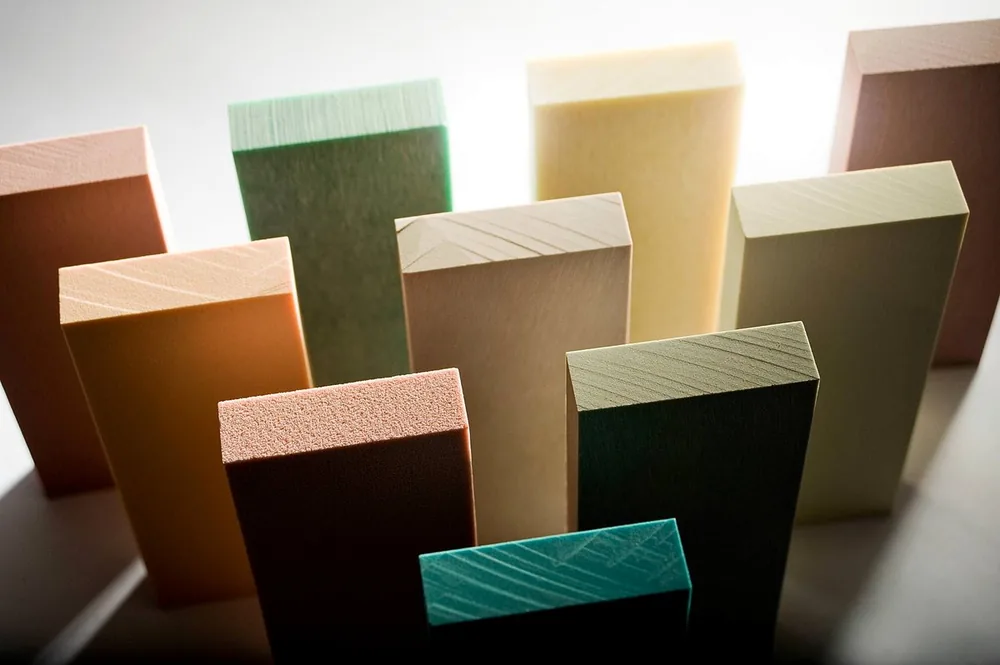
Reference: tooling board manufacturer, Moscow region
A producer of tooling boards — model plastic for master models, moulds and jigs — runs the polyurethane configuration of this line. The properties that make the board preferable to wood come directly from the equipment: uniform density from continuous metering, a closed cell structure from dust-free microsphere feeding, and no entrained air after vacuum degassing.
Those three points decide cut quality on a CNC router and the dimensional stability of the finished tool, which is what the customer is actually buying.
Questions and answers
What is the advantage over a polyester composite?
No styrene emission, so post-curing chambers and warehouse dwell time disappear from the cycle and workshop ventilation requirements are lower. The material is also UV stable and stronger and more elastic at the same mineral loading.
What are microspheres for?
Hollow polymer or glass spheres replace part of the filler and give a closed cell structure: lighter material, uniform density and better dimensional stability. They are metered by a dust-free ATEX feeder, because handling them as a loose powder is both a dust and an accuracy problem.
What is a tooling board?
Model plastic used to machine master models, moulds and jigs. It is cast from polyurethane or epoxy resin with inert fillers and microspheres, classified by density, supplied in blocks and bonded into larger blanks.
Why is the mixing head faster than on the polyester line?
Polyurethane components have a short reaction window and must be homogenised before gelation starts. The patented low-pressure head is infinitely variable up to 6000 rpm against 3000 rpm on the polyester configuration.
Is there a fixed model range and a price list?
Yes. The VAC-2/15 base line, with an output of up to 15 kg/min, costs RUB 8,142,000 excluding VAT and is configured for your product with options — feeders, microspheres, colour lines, automatic loading. All prices are public in the configurator (in Russian) and are valid until 31 December 2026. Lines with other outputs and custom builds are engineered to your technical specification and quoted once it is agreed.
Which countries do you supply?
China, India, the Middle East, the CIS and Russia. Correspondence and documentation in English or Russian; the control software interface is supplied in the language agreed for the project.
Who manufactures the equipment?
SARMATECH LLC, Leningrad Oblast, Russia; on the market since 1998, legal entity registered in 2021. The machines carry the AUTOCASTER® mark; the line and its control software carry the POLYBLENDER® mark.
Equipment catalogue
Polyurethane casting line — full catalogue
Unit-by-unit description, bought-in components and the metering, mixing and vacuum degassing parameters. Illustrated PDF, 13 pages, 28 MB, with a text layer.
Let's discuss your project
Tell us what you intend to produce and at what volume. We will propose a configuration for your binder system and prepare a quotation. We ship to China, India, the Middle East, the CIS and Russia.
Ecosystem
Other products by SARMATECH LLC
Equipment, materials and finished products from a single manufacturer. Every line runs on in-house continuous metering and mixing units.
Machine-readable data: llms.txt · AGENTS.md · sitemap.xml
SARMATECH LLC, TIN 4725011864, PSRN 1214700012890.